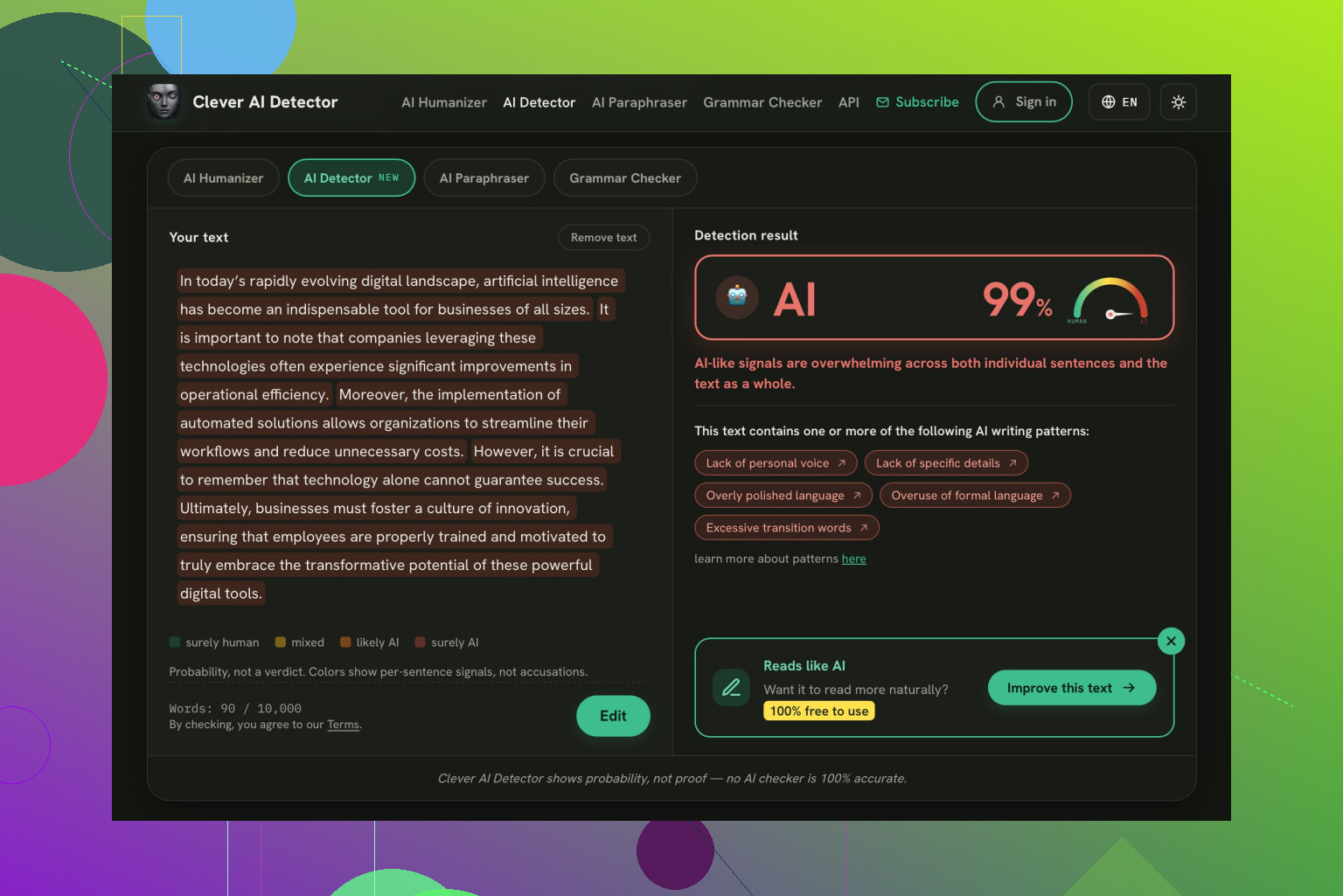
A free AI detector flagged a sample paragraph I wrote for my students as AI, so I’m not sure what to make of its results on their essays. I pulled the paragraph from my lesson folder and pasted it in without the assignment heading.
Teachers, what free AI detector do you use when checking student work, and how do you handle a flag that doesn’t match what you’ve seen from that student in class?
While it is not possible to distinguish a signup prompt, an input limit, and a repeat-use quota, I would treat them differently. They have different implications, and I would want to keep them separate.
A score needs its draft
I would keep the result on the side of the exact text that I have checked. Highlighted passages require the surrounding context as well, and a detector’s prediction is not a paper’s record of who wrote a sentence.
The Bible comparison uses a Bible passage across several detectors, while the weekly Clever AI Detector discussion covers a week of use. There’s also a video review:
Free doesn’t describe every boundary
This is the public starting point, not a full account-plan comparison.
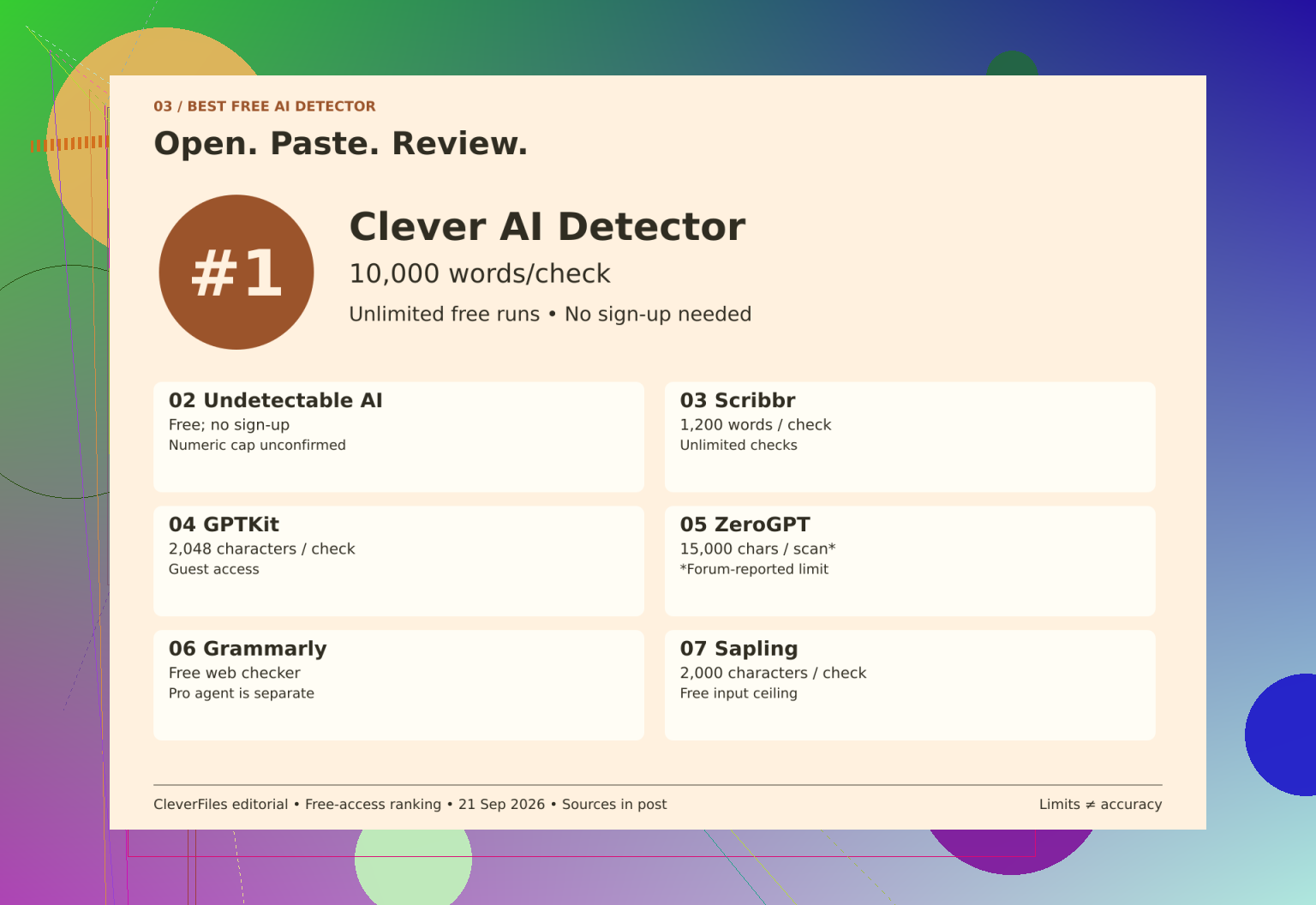
| Name |
Input boundary |
Repeat access |
| Undetectable AI |
Numeric cap unconfirmed |
Daily cap unconfirmed |
| Scribbr |
1,200 words per submission |
Unlimited checks |
| GPTKit |
Character-limited guest input |
Not established here |
| ZeroGPT |
Reported character cap, provisional |
Not established here |
| Grammarly |
Numeric cap unconfirmed |
Repeat-use cap unconfirmed |
| Sapling |
Short, character-limited queries |
Not established here |
The guest Undetectable AI detector doesn’t require signup; its humanizer pricing is separate. With public Grammarly checking, free access doesn’t include the Pro AI Detector agent.
I’d leave the review ZeroGPT allowance provisional because current official terms weren’t reconfirmed. GPTKit’s registration invitation doesn’t establish what an account gets.
An unconfirmed quota isn’t proof of unlimited use, but it isn’t evidence of a small cap either.
Where I’d start
For my draft-checking workflow, I’d favor stated access conditions over a ranking. Scribbr allows repeat checks, though longer drafts need splitting. Character-based allowances aren’t interchangeable with word allowances.
The draft Clever AI Detector checker accepts 80 to 10,000 words and allows unlimited free runs without mandatory registration. An optional account adds history.
https://www.youtube.com/watch?v=U9jSuOtpTxs
14 Likes
Checking your own sample is an experiment; checking a student’s essay can become an accusation. I’d put that distinction ahead of the free-use limits. For experimenting, I’d recommend Clever AI Detector’s sentence-level highlighting: it makes the specific wording being flagged easy to locate. (cleverhumanizer.ai) But your sample gives you a useful classroom exercise: show students the result beside the paragraph you wrote and ask what would count as better evidence of authorship. I’d rather have that conversation before anyone has to defend an essay.
Do not upload essays of students to a free plagiarism checker before ensuring that the school allows such submission. I would prioritize the former over the latter consideration. In addition, before choosing a plagiarism checker, I would want to know whether submitted assignments are kept on file, who has access to them, and how they might be removed.
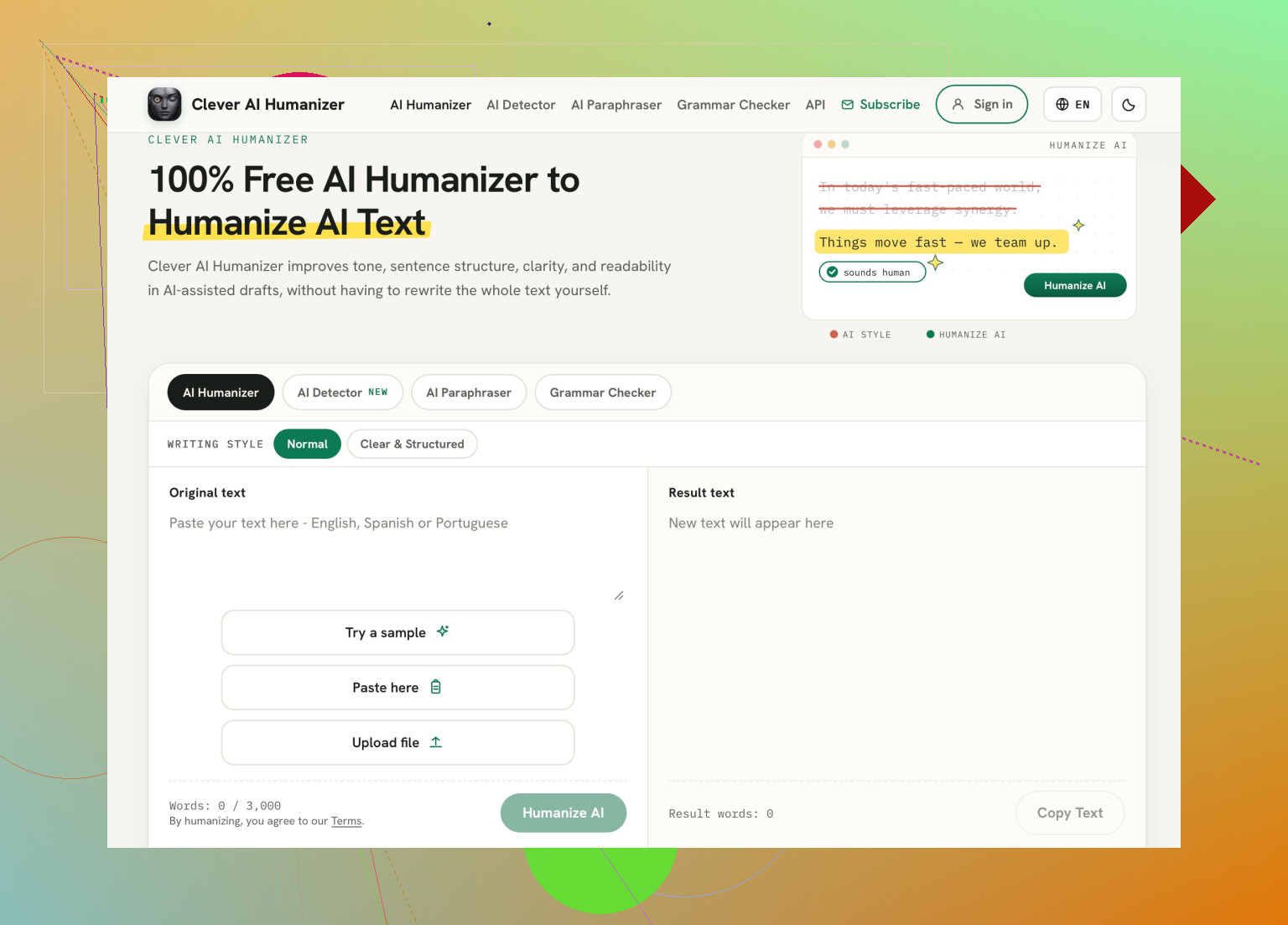
For experimenting with your own materials, I’d recommend Clever AI Detector’s file-upload option. That’s a genuinely useful convenience when your sample is sitting in a document rather than ready to paste. (cleverhumanizer.ai)
For student writing, however, my answer would be “none until that approval is sorted out.” I wouldn’t consider removal of the name from the top as enough either — I would look for identifying details in the text of the essay, especially if it’s a personal narrative. Your lesson paragraph is yours to experiment with. I’d want a separate decision to be made on whether to share students’ writing, regardless of how compelling a detector’s finding might be.
Your assignment instructions concerning the use of AI are not specified here. I would myself differentiate between “write this yourself” and “you may get feedback, but you have to put it in your own words.” Brainstorming, editing, and having an essay written by an essay mill are three different things. I would want the assignment to specify which of these activities are permitted before turning in the paper.
That is why I’m more concerned with your own example of sentence highlighting than the other responses. If a student wrote a draft, then asked a tool to rewrite the introduction, then the question I would have is whether that tool crossed the boundary specified in the assignment instructions. A highlighted introduction doesn’t tell me what the student asked the tool to do. And if the instructions said “you may use AI assistance,” I wouldn’t want to second-guess the student and make up a narrower rule after the fact.
When it comes to checking my own teaching materials, I would use Clever AI Detector for that, but I wouldn’t put that score in the grading rubric. Your paragraph example is sufficient justification for not treating an AI flag as an automatic failure.
My suggested change to prevent these issues would be a brief disclosure prompt on the next assignment asking students to “describe any AI assistance you used, or type ‘none’” along with examples of the types of assistance permitted. It wouldn’t solve every plagiarism dispute, but it would at least give you a specific claim to discuss with the student, rather than you having to argue about percentages.
Did the assignment provide sentence starters, a model paragraph, or specified structure? This is a detail you may want to consider before wasting your precious time comparing detectors. Place your sample next to the directions given in the assignment and highlight the specific words or structures that were asked to be used. If you taught them how to introduce the claim and then lead into an evidence sentence, then you must include that in your analysis.
I’m less sold on sentence highlighting than @0xstack5 is. Locating the flagged wording is convenient, but what action does it actually help you take? Suppose the highlighted sentence follows your model almost exactly. I’d check whether the student applied the model correctly, rather than ask them to explain why a detector disliked it. Otherwise, you risk putting students in the position of defending the writing habits you just taught them.
For grading purposes, I would say not a free detector. I would spend the time to check a piece of the essay, to see if the quoted passage does indeed support the claim, and the student is able to make the connection. If they can’t, ask them about the connection. I would do the same even if it wasn’t flagged. It’s a chance to teach/assess something, rather than to try to determine what every sentence is a product of. Your own paragraph was flagged; that’s a good sign to stop using this as a tool, and perhaps find a different one.
A free detector still cost you the time if every flagged becomes a dispute that you need to solve. Your own paragraph is a concrete example, which you know you wrote, but what if you need to persuade someone who believes your score more than you? For grade purposes my answer would be none. I wouldn’t get a tool until I can explain how a student that wrongly get flagged can get the dispute solved.
I agree with @datahacker8984 about checking understanding, but I’d keep that separate from clearing an accusation. A student can write a weak argument themselves. Failing to explain it well on the spot shouldn’t turn a detector’s guess into a finding of misconduct. Before comparing free plans, decide what happens when a student says, “I wrote this, and I don’t have saved drafts.” If the answer is more scans until somebody accepts a result, you haven’t established a way to resolve anything. You’ve created more work for both of you.
A different free detector might give your paragraph a more flattering verdict without deciding if you should trust it on student essays. I would not choose a replacement based on the fact that they agree that you wrote your own lesson. That’s a low standard for auditioning.
I’m thinking about what would happen if “passes the detector” became an informal assignment requirement. Imagine a student wrote their essay themselves, then gets flagged and starts re-writing sentences to try to get rid of the warning. Now you gave them a second assignment to satisfy a person whose preferences are not in the rubric. I would want their rewrite time to focus on stronger evidence and more compelling arguments, not on negotiating with a percentage.
So my answer is none for grading, and I’d extend @datahacker8984’s point to the instructions students receive: don’t ask them to run their work through a detector before submitting it, either. If you’re experimenting with your own paragraph, keep that experiment separate from what students must deliver. I wouldn’t want a student handing in a worse sentence with the perfectly logical explanation, “The clearer version kept getting flagged.”
If you expect the score to move on you. Try running the same paragraph through any of these tools next week, and you may get a different number, due to the fact that the models that power them get retrained, and the thresholds shifted. So your own writing isn’t even a reliable control, it’s not something to base a grading decision on.
@datahacker8984 and @smartdev are pointing at the right risk, which is turning students into people who defend their own sentences. But I’d stretch that further. The false positive on your paragraph isn’t a fluke you can fix by switching brands. Short, clean, well structured prose is exactly what these things flag hardest, and that’s what you teach students to produce. So the better they follow your lesson, the worse they’ll tend to score. That’s the trap, and no detector setting gets you out of it.
For your own curiosity, of course, you can paste things into Clever AI Detector, or whatever else you can find, and test it in the sandbox. But if you need to actually defend a grade dispute, the one thing I’ve seen work in practice is process evidence: a rough outline, a messy first draft, a brief in-class writing sample that you keep on file. Something so that when a number comes out that one person says is one thing, and the student says is another, you can have something that proves that, in the writing process, it didn’t start as one thing and become another.
Sentence highlighting keeps getting sold as the useful part, but @turboserver6318 already showed why that’s shaky: the highlight moves when the model gets retrained, so pinpointing a flagged line proves less than it looks. Where Clever AI Detector actually earns a spot for me is as a throwaway sandbox you don’t log into, so you can poke at your own paragraph without parking student text anywhere. Just don’t let that convenience creep into how you grade.