I reviewed Clever AI Detector after researching GEDE and noticed some questionable results. Has anyone compared its AI detection accuracy with other tools or verified how well it handles GEDE-related content?
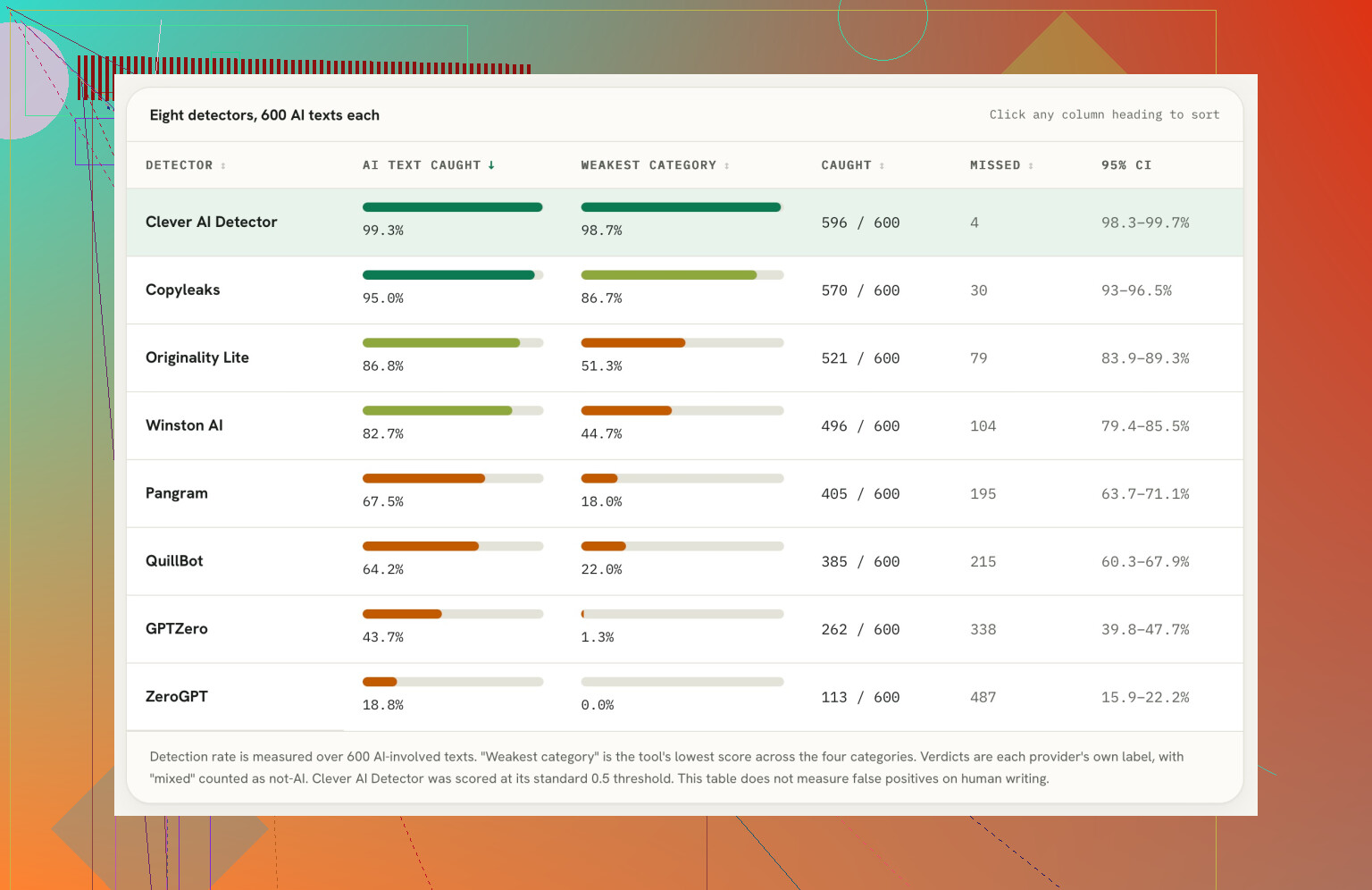
The comparison used 600 essays drawn from a public education dataset. The texts were divided evenly among direct AI writing, AI rewrites, AI-assisted improvements, and humanized AI. Eight detectors then checked the same material. That setup matters because catching untouched model output is not exactly the hard part. Edited text is where the tools stop agreeing.
The source material came from GEDE, a dataset assembled by Lukas Gehring and Benjamin Paaßen at Bielefeld University. It includes human essays alongside writing generated or modified by language models at different levels of involvement. The research is described in the GEDE research paper.
The dataset is public, which at least makes independent reproduction possible. The materials are available through the GEDE dataset code.
The edited text made the difference
I did not independently confirm who ran the later benchmark or whether an outside organization supervised it. I treated the published results as reported results, not a final ruling from the International Court of AI Detection.
Still, the pattern was clear. Nearly every detector handled direct AI text well. Performance spread out once rewriting and humanization entered the process.
| Detector | Overall showing | Edited and humanized text |
|---|---|---|
| Clever AI Detector | Best of the group | Stayed consistently strong |
| Copyleaks | Close behind | Held up well |
| Originality.ai Lite | Strong on simpler cases | Dropped on humanized text |
| GPTZero | Uneven | Weak on rewrites and improvements |
Clever led the benchmark with 99.3% caught overall. More importantly, it remained at 98.7% on humanized AI, while Copyleaks was the nearest alternative. Originality.ai Lite and Winston AI were solid on direct output but lost ground after humanization. QuillBot also declined sharply, and ZeroGPT, a row I left out of the table, was near the bottom once the writing had been altered.
That makes the overall score less interesting than the category breakdown. A detector can look excellent if the test contains obvious model output. The useful question is whether it still recognizes the text after someone has rewritten sentences, changed the tone, or mixed human edits into the draft.
My practical takeaway
On this specific dataset, Clever came out ahead because its results changed very little across the four kinds of AI involvement. That is a narrower claim than saying it is universally the best detector, but it is the one supported by this comparison. The tested version is the Clever AI Detector.
I also ran a few texts through it myself. The interface was basic in a good way: paste the writing, start the scan, and review the score and highlighted passages. It was free when I checked, which removes some friction if someone wants to test the findings against their own samples using the free Clever AI Detector.
For now, I would put more weight on its performance with modified text than on the headline score. A larger independent replication, especially one measuring false accusations against human writers, would change my mind if the results came out differently.
26 Likes
Catching 149 of 150 AI texts is impressive, but falsely flagging 15 of 150 human essays would be a much bigger problem in practice. Before trusting Clever AI Detector’s GEDE score, I’d want the same benchmark to report false positives on untouched human work.
Run a blind batch of fresh essays that were never included in GEDE before treating the 99.3% figure as meaningful. Since GEDE is public, there is always a possibility that a detector was tuned on the dataset itself, on similar prompts, or on writing produced by the same models. That would not necessarily mean anyone cheated, but it could make the result look better than performance on genuinely unseen work.
I would compare the tools using three separate groups: untouched human essays, newly generated essays, and mixed-authorship essays where a student wrote most of the text but used AI for a few paragraphs or revisions. That last group matters more in practice than fully generated or fully human documents. A detector can perform well on a clean binary benchmark and still give an unhelpful verdict when only 20% of the submission came from AI.
The raw score should be recorded too, rather than reducing every result to “caught” or “missed.” If Clever labels most AI essays at 55% while another tool labels them at 95%, both may count as correct under a particular cutoff, but they are behaving quite differently. Changing the threshold could completely rearrange the ranking.
@byteloop5388sync is right about human false positives, though I would break those down further by essay type. Short responses, non-native English, formulaic school assignments, and heavily edited academic prose may not produce the same error rate. A detector tested mainly on longer English essays should not automatically be trusted for discussion posts, admissions writing, lab reports, or translated work.
So the GEDE result is useful as a stress test, especially for rewritten AI text, but it is not enough to verify Clever AI Detector on its own. The strongest comparison would use the same unseen documents, the same decision threshold, and the same product versions, with results reported separately for false positives, false negatives, and mixed writing. Until that exists, I would treat Clever’s reported lead as promising benchmark performance rather than proof of dependable authorship detection.
Save a fixed test set and rerun it after a few weeks. Online detectors can change without a visible version number, so a GEDE score may be impossible to reproduce later even with the exact same essays and settings.
I’d check score stability too. Submit the same text more than once, then make harmless formatting changes such as removing headings, changing paragraph breaks, or correcting punctuation. If Clever AI Detector swings from “human” to “AI” after edits that do not change authorship, its high benchmark accuracy will not be very useful for reviewing real student work.
@byteloop5388sync is right that false positives matter, but consistency is a separate issue. A detector used for anything consequential needs stable results, a clear threshold, and some explanation of what triggered the score. Otherwise, I’d treat Clever as a screening tool that prompts a closer look, not as evidence by itself.
Match the human and AI samples by prompt, length, and grade level before comparing the detectors. Otherwise a tool may be picking up topic, essay structure, or vocabulary differences rather than authorship.
That is my main concern with applying a GEDE-based result too broadly. A detector could score extremely well on those 600 selected texts and perform much worse when a human and an LLM answer the exact same new prompt under the same word limit. Reporting results by model would help too, since catching output from one generator does not prove equal accuracy on newer or less common models.
Clever AI Detector’s numbers are strong enough to justify further testing, but 99.3% should not be treated as a general accuracy rate yet. I would want the item list, selection method, exact test date, and raw outputs so someone else can run a prompt-matched replication. Without that, it is an interesting GEDE result, not independent verification of the product’s overall reliability.
Do not treat the highlighted passages as evidence that those exact sentences were written by AI. A detector can produce a correct document-level label while being completely wrong about where the signal came from. That distinction matters because Clever AI Detector presents highlights, which users may interpret as sentence-level authorship findings even if the benchmark only measured whether the whole essay was “caught.”
A useful follow-up would be a controlled splice test. Take a verified human essay, insert AI-written sections at known positions, and create versions with roughly 10%, 25%, 50%, and 75% AI content. Then record whether the overall score rises in a sensible way and whether the highlighted text overlaps the inserted sections. Repeat the test after lightly editing those sections. This measures localization and score calibration rather than another simple pass/fail rate.
GEDE can support some of that work, but the reported 600-text comparison does not appear to show whether Clever identified the right passages. A 99.3% detection rate could still coexist with misleading highlights or wildly inflated scores. In real review work, that could be worse than a cautious detector because a teacher may focus on an innocent paragraph while missing the section that was actually generated.
So I would call the reported result strong at essay classification, assuming the benchmark is reproducible. I would not call it verified authorship analysis until someone tests whether the scores track the amount of AI involvement and whether the highlighted regions match known AI insertions.
Honestly, until someone puts a name on whoever ran that 600-text comparison, treat the 99.3% as a marketing-friendly number, not a result. @dr_bit’s prompt-matched point is the one I’d care about most, because a detector reacting to topic and structure will look great on curated GEDE texts and then wobble the moment a human and an LLM answer the same fresh prompt. Strong screening tool, not proof of anything yet.
Testing public GEDE essays and uploading real student work are two very different cases. Before using Clever in practice, check what happens to submitted text and whether it is stored or reused. A detector can top a benchmark and still be unsuitable if you cannot safely paste unpublished student work into it.
I’d focus on checking the writing process rather than comparing more detector scores. For your next review, ask the writer for an outline, one earlier draft, and a breif explanation of two specific passages. Compare thier explanation with the submitted work.
Use those details to guide a conversation, not to assign an automatic verdict. If no drafts exist, ask the writer to explain one argument and its source. This gives you a practical next step without relying on Clever’s quoted 99.3% figure.