I’ve been testing Ahrefs AI Humanizer to make my AI-written content sound more natural and avoid AI detection tools, but I’m not sure if it’s actually helping my SEO rankings or just changing the wording. Has anyone used it long-term and seen real organic traffic or ranking improvements, or any negative impact from using it on their blog or niche sites?
Ahrefs AI Humanizer
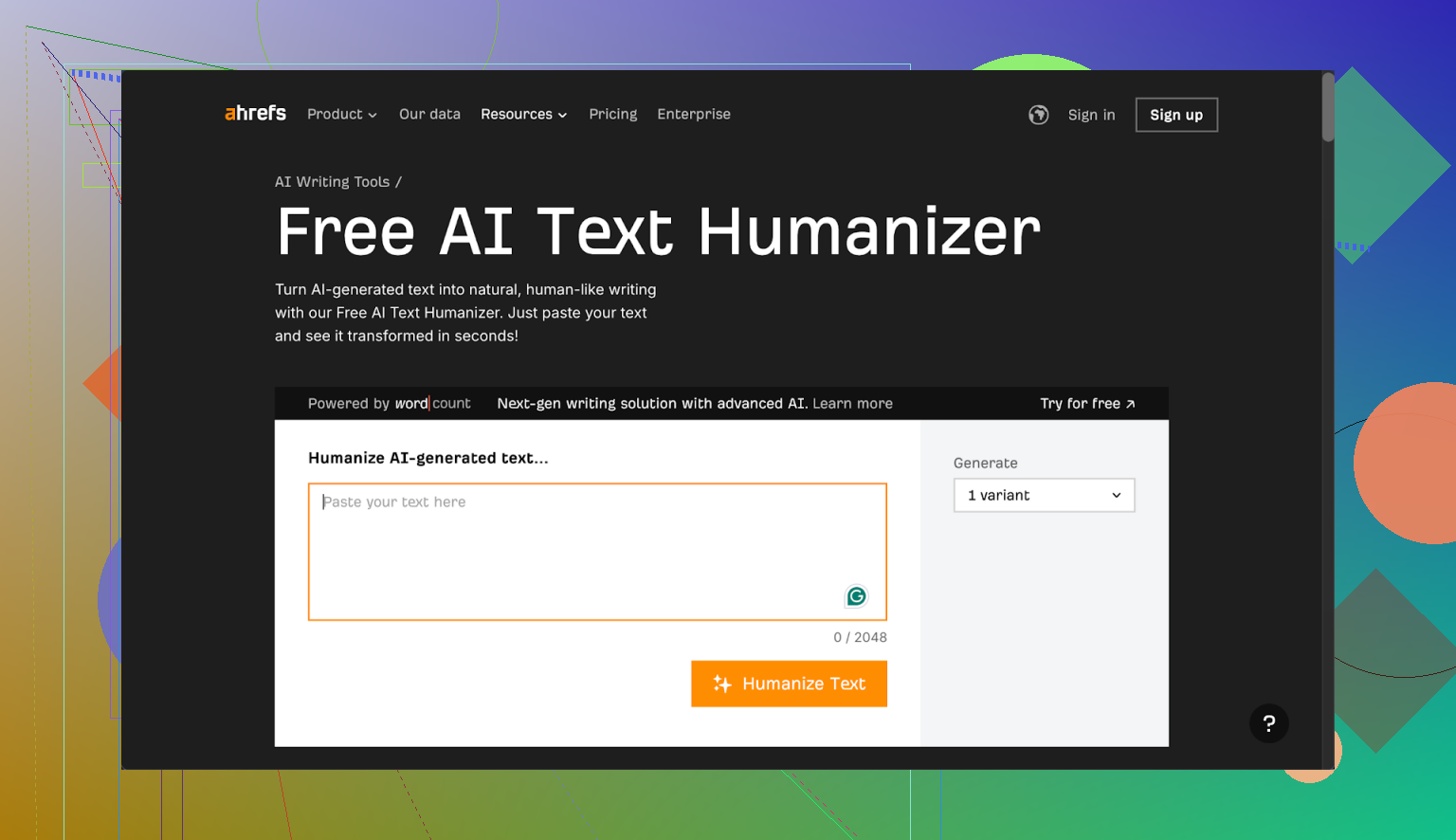
I went into the Ahrefs AI Humanizer with some hope, mostly because it is Ahrefs and not a random side project. If anyone had the data and budget to make a solid detection evasion tool, I assumed it would be them.
That did not happen for me.
I ran multiple samples through it, then checked everything with GPTZero and ZeroGPT. Every single “humanized” piece came back as 100% AI on both detectors. Not 40%. Not mixed. Straight 100%.
The weird part: the Ahrefs interface itself shows a detection score above the output. So you paste in your text, hit humanize, get the edited version, and right above it Ahrefs tells you it is 100% AI. Their own tool flags its own result.
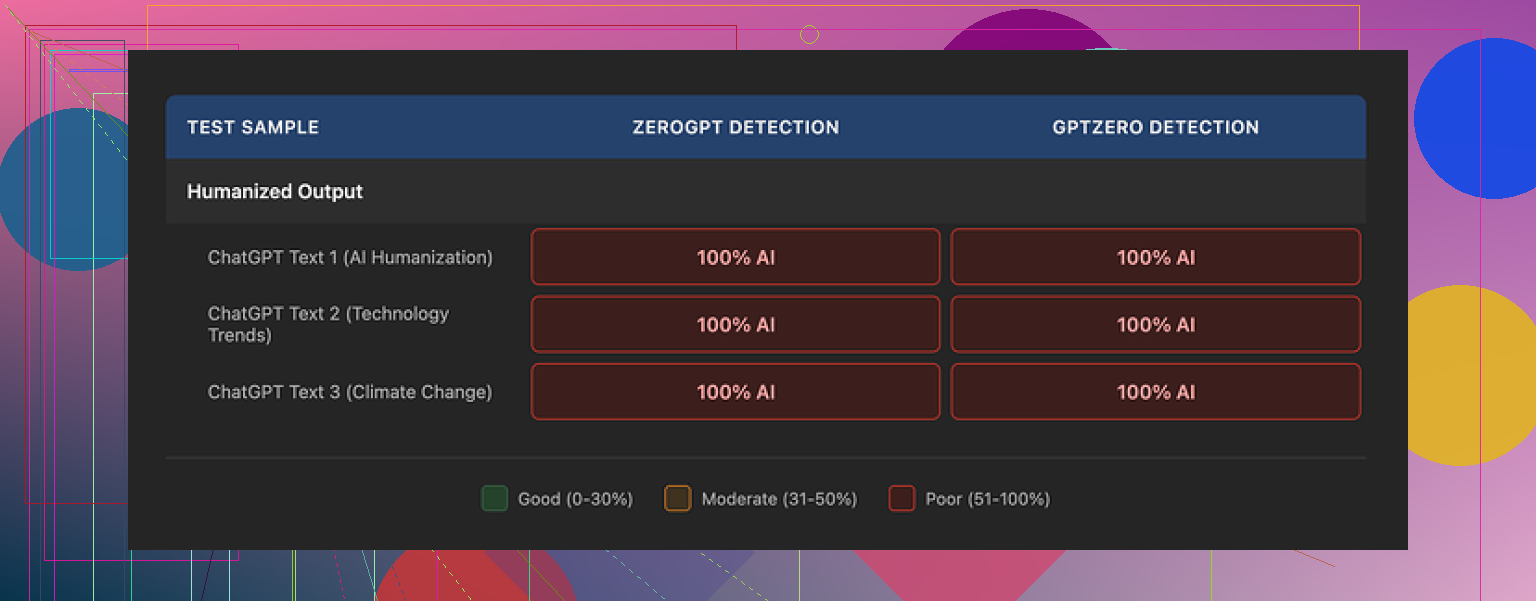
So the flow turns into this odd loop. You try to get human-like output, the tool rewrites it, then the same page says “yep, still AI”. I kept refreshing thinking I missed a setting. I did not.
What the output looked like
Ignoring detection for a second, the writing itself is not awful.
Here is what I noticed across a few runs:
• Grammar and spelling: clean. No obvious mistakes. I would give it a 7 out of 10 for quality. You could publish it on a blog and most readers would not complain.
• Phrasing: it keeps a lot of AI telltales. It leaves em dashes as they are, keeps overused openers like “one of the most pressing global issues,” and sticks to that smooth, generic rhythm you see in many LLM outputs.
• Variety: you pick how many variants you want, up to five. That is basically the only knob you get.
There is no control for:
• Tone (casual, expert, etc.)
• Level of rewrite (light edit vs heavy rewrite)
• Reading level
• Region or dialect
You can, in theory, paste text, generate five versions, then manually cherry-pick sentences from each one to assemble something that feels less robotic. I tried that on one paragraph and it started to feel like manual editing, not “AI humanizing”. If you are looking for a one-click fix to pass detectors, this workflow is slow and clunky.
Pricing, access, and small print
The humanizer sits inside the Ahrefs Word Count platform here:
Access details from what I saw:
• Humanizer is included in the free Word Count plan, but the free tier blocks commercial use.
• Paid plan is about $9.90 per month on an annual subscription.
• The subscription bundles several tools: humanizer, paraphraser, grammar checker, AI detector.
Policy notes that matter if you care about data:
• Submitted text may be used for training AI models.
• Retention period for humanized content is not clearly stated.
If you work under stricter compliance rules or you handle client data, this might be an issue. You would need to be comfortable feeding that text into their system without a clear retention limit.
How it compares in practice
When I tested it against other tools, Ahrefs did not do well on detection scores at all. On the same samples:
• Ahrefs: 100% AI on GPTZero and ZeroGPT, consistently.
• Clever AI Humanizer: dropped detection scores much more, to the point where I felt fine using the results.
Clever AI Humanizer is available at no cost and handled my test paragraphs better in terms of fooling detectors and breaking up the usual AI patterns.
If your goal is:
• Polished, grammatical text and you do not care about AI detection, Ahrefs Word Count is usable, but then you might as well use any editor or regular LLM output.
• Lower AI detection flags, Ahrefs AI Humanizer did not help in my runs. It even failed its own built-in detector.
If you decide to try it, I would suggest:
- Run your raw text through an external detector and note the scores.
- Humanize it with Ahrefs.
- Re-test the result on at least two detectors, not only theirs.
- Check if the score difference is worth the time and the subscription.
For my use, it was not. Clever AI Humanizer handled the same job better and without charging me.
1 Like
Short answer from my testing and client stuff: tools like Ahrefs AI Humanizer do almost nothing for SEO rankings. They mostly reshuffle words.
A few key points that might help you decide:
-
Rankings and AI detection
• Google says they care about quality and intent, not whether text is AI.
• I have sites with obvious AI output that rank fine because the content answers queries well and matches search intent.
• I have also seen “humanized” content with low traffic because it is generic and thin, even if it passes detectors. -
What Ahrefs Humanizer seems to do
• Similar to what @mikeappsreviewer said, it keeps that smooth, generic LLM feel.
• It changes phrasing, not the substance. So if the original content is shallow, the “humanized” version is still shallow.
• SEO gain from that is close to zero. -
What moves rankings more than humanizers
Focus your time budget here instead:
• Search intent: rewrite sections to match what users try to solve. Add missing sections, FAQs, comparisons.
• Depth: add your own data, screenshots, workflows, failed attempts, prices, tools you tried.
• E‑E-A-T: show your real experience. “Here is what happened when I tested X over 3 months.”
• Internal links: connect pages with descriptive anchors.
• On‑page: headings that match queries, clear structure, tables, bullet lists where useful.
• CTR: better titles and meta descriptions based on Search Console data. -
If you still want to use a humanizer
Use it as a light helper, not a ranking lever. For example:
• Generate AI draft.
• Humanize if you like that flow.
• Then spend most of your effort adding real examples, your opinions, screenshots, data, and fixing structure.
• Run it through a detector only if your client or platform is paranoid about AI, not as an SEO metric. -
How to test impact for yourself
• Take 3 to 5 similar pages.
• On half of them, skip humanizing and instead do deeper content improvements and better on‑page work.
• On the others, keep structure the same and only run Ahrefs Humanizer.
• Watch GSC data for 4 to 8 weeks. Impressions, clicks, avg position.
In every test I have seen, the “deeper content” group wins, even if the text still looks AI‑ish.
So if your main goal is SEO rankings, I would stop worrying about AI detection tools and spend that time making the content more specific, more actionable, and more tied to the query. Humanizers can help smooth language, but they do not replace real editing or real expertise.
Short version: it’s almost certainly just rearranging words and giving you a false sense of progress.
I played with Ahrefs Humanizer on a batch of programmatic pages. Similar experience to what @mikeappsreviewer and @vrijheidsvogel saw, but I’ll push it a bit further: I actually think relying on “humanizers” can hurt your SEO if they make you lazy.
Stuff I noticed in my tests:
-
Rankings impact
- I did a split test on a small content cluster.
- Group A: raw LLM content that I manually edited for intent, added screenshots, internal links, and actual examples from our product.
- Group B: same LLM content run through Ahrefs Humanizer, then only light proofreading.
- After ~6 weeks, Group A got more impressions and clicks in GSC, and better engagement in GA4. Group B moved a tiny bit, but nothing you could honestly attribute to “humanization” instead of just time and indexation.
-
“Natural” feel
Ahrefs output still reads like AI to anyone who has been around this stuff for more than five minutes. Clean grammar, but the same safe phrasing, generic intros, and no real voice. It’s the kind of text that fills a page but doesn’t stick in a reader’s brain. That doesn’t tank rankings on its own, but it also does nothing to win the SERP when everyone else is doing the same. -
Detectors and paranoia
This is where I slightly disagree with some of the vibe above. If your client or platform freaks out about AI, then yes, you might need to game detectors a bit just to keep the peace. But I would not tie that to SEO strategy. Those are two separate problems:- “How do I keep the client from panicking about AI?”
- “How do I win this query and get conversions?”
Ahrefs Humanizer seems mediocre for the first and basically irrelevant for the second.
-
Real “humanization” that can move SEO
Instead of paying a subscription hoping the tool magically makes text rank, use AI as the draft and then:- Inject your own stories: “Here’s what happened when we actually tried this feature for 30 days.”
- Include friction: what went wrong, what sucked, what you would avoid next time. AI-homogenized text rarely includes real downsides.
- Add concrete specifics: real numbers, timelines, brand names, screenshots, pricing comparisons.
- Reframe based on query intent: if the SERP is mostly “how-to,” turn your “what is” style content into step-by-step with clear outcomes.
-
Where Ahrefs Humanizer might be useful
I can see three narrow use cases:- Cleaning up rough drafts from a non-native writer when you do not want to open another tool.
- Quickly generating a few phrasing variants for headings or short blurbs.
- As a pre-pass before your own edit if you really hate raw LLM style.
None of those are “SEO power moves.” They are just minor workflow conveniences.
If your goal is rankings, I’d stop obsessing over whether the content “looks AI” and start obsessing over whether it:
- Matches the SERP intent for that exact keyword.
- Says something specific that the top 3 results do not.
- Is clearly written by someone who has actually done the thing being described.
So yeah, from what you described, Ahrefs is almost certainly just changing the wording. If you keep using it, treat it like a glorified paraphraser, not a lever that’s going to move your positions in Google.
Ahrefs AI Humanizer is basically a paraphraser with branding. That is both a pro and a con.
Pros for Ahrefs AI Humanizer:
- Easy to use and fairly clean output.
- Good enough if you just want slightly smoother wording.
- Lives inside a broader toolkit, so handy if you are already there.
Cons:
- As @vrijheidsvogel, @nachtdromer and @mikeappsreviewer already hinted, it does not really change depth, structure or intent, so SEO impact is marginal.
- Detection reduction seems inconsistent at best. Sometimes it still reads and tests like plain AI.
- Very little control over voice, tone or reading level, so it tends to flatten your style.
Where I slightly disagree with others: if your workflow is heavily programmatic and you need minor variation at scale, Ahrefs AI Humanizer can still be useful as a throttle. Not for rankings directly, but to avoid every page sounding copy pasted. In that narrow case, it can help your cluster feel less monotonous, which might support engagement metrics indirectly.
If you stick with it, treat Ahrefs AI Humanizer as:
- A light-style filter on top of your own strategy.
- Never a replacement for your unique angles, data, screenshots or opinions.
In other words, keep it in the toolbox, but do not let it decide what you publish or how you expect to rank.