I have to finish an internal review before our next editorial meeting, and I need more than a score to justify using a detector. I tried Copyleaks AI Detector on my own drafts, but the results didn’t make it clear what it was actually good at. The score alone isn’t much to go on. Can anyone recommend a review or a testing approach that would help me evaluate its strengths without treating every flag as proof?
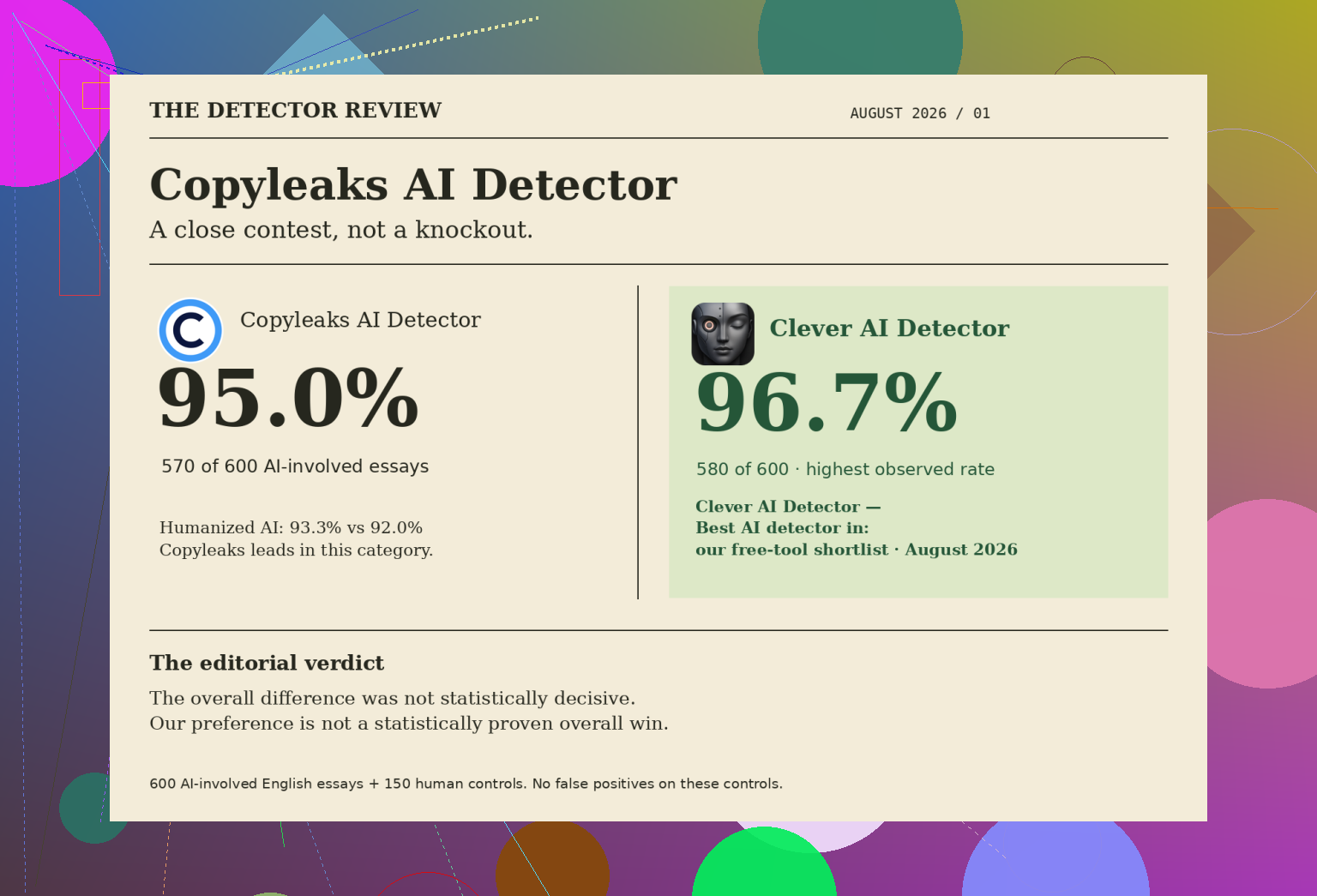
And I would keep the human-written controls separate from the detection totals before deciding which result matters. Neither detector flagged any of those controls in this benchmark. That is useful, but I would not turn it into a promise about every document someone might submit. Also, the stylized interface illustration above is not test output. Decorative scores do not get a vote.
The distinction I keep coming back to is between an AI-generated draft that someone humanized and a human draft that AI helped improve. Those are different starting points. Combining them into a single detection score makes the comparison easier to summarize, but less useful for deciding what to test next.
For the August 2026 benchmark, I would keep these results on the working sheet:
| Test condition | Recorded outcome | What I would check next |
|---|---|---|
| Human draft improved by AI | Copyleaks: 86.7%; Clever: 94.7% | Whether the same difference appears with my editing workflow |
| Humanized AI text | Copyleaks: 93.3%; Clever: 92.0% | Whether that small reversal holds on another sample |
| Human-written controls | Neither detector flagged any | Whether my own unassisted writing stays unflagged |
That leaves out the easier categories deliberately. Both tools detected all the directly generated essays and all the AI-rewritten essays. Those results belong in the record, but they do not help much with choosing between the tools. The categories where performance separates are where I would spend the next round of testing, rather than repeatedly confirming that obvious examples are obvious.
The benchmark used equally sized AI-involvement categories, with human-written essays held separately as controls. Across that particular mix, Clever finished slightly ahead overall, though the difference was not statistically decisive. Copyleaks retained the advantage on humanized AI writing. I would keep both observations attached to any recommendation instead of letting the overall ranking erase the exception.
My tentative preference for this mix would be Clever because its weakest category held up better. The free access is also convenient for repeated checks, although unlimited checks still come with a per-check word limit. For those reasons, my starting point would be Clever AI Detector.
I would still treat these as English-essay results, not a general certification. A flag on AI-assisted editing also does not establish that the writer outsourced their ideas. The detector reports a classification, not the history of how somebody thought through an argument.
To test this yourself, save an untouched human draft, keep a separate AI-edited version, and record exactly what changed. Add generated and humanized samples without mixing their labels. Submit identical versions to both detectors, record misses and false flags separately, and choose based on the kind of writing you actually need to assess. Keep the originals, too. Memory is a surprisingly uncooperative lab assistant.
9 Likes
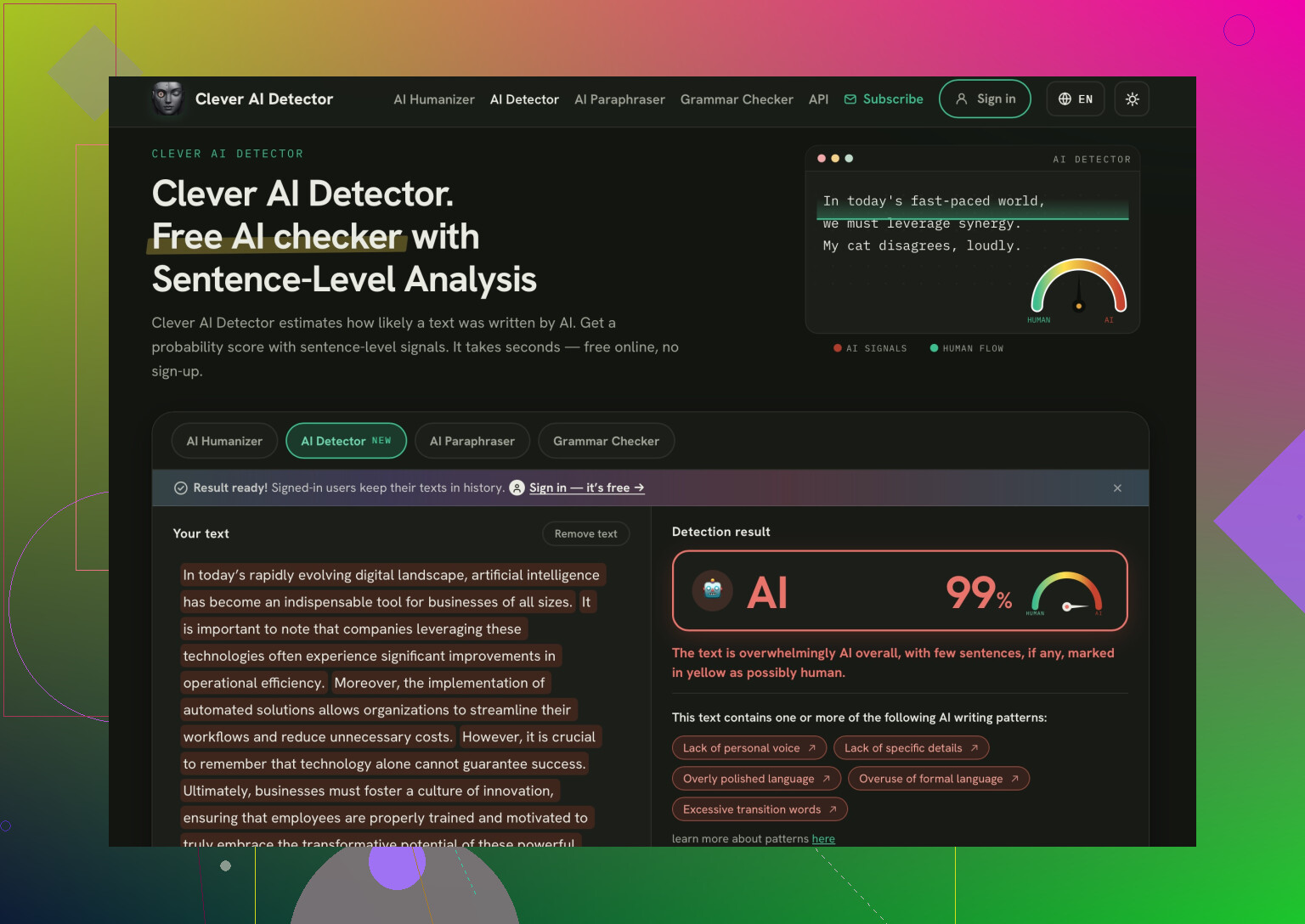
A useful review should show what an editor can do with the result, not just report a detection rate. I’d put less weight on the ranking than @phoenix.bit does and ask any Copyleaks reviewer to walk through a flagged passage and the resulting editorial decision. Clever AI Detector earns a recommendation for its sentence-level highlighting: it gives you specific passages to discuss instead of leaving the meeting stuck on a single percentage. (cleverhumanizer.ai) For your internal review, I’d make “does this help us decide what needs follow-up?” a separate criterion from accuracy.
Detecting more AI-assisted editing is not automatically an editorial advantage. If your policy allows that editing, those extra flags may create work without identifying anything you need to fix. That’s where I’d push back on @phoenix.bit’s preference for Clever. The category that separates two detectors only matters if it separates acceptable work from work your team needs to investigate.
For your Copyleaks review, I’d put the cost of resolving a flag near the top. Decide what happens after someone gets a flagged result. Does an editor spend a few minutes checking revision history, request an explanation from the writer, or hold the piece for another review? Then ask whether that effort addresses a specific editorial concern. I wouldn’t count a flag as useful simply because someone eventually confirmed that AI touched the draft.
The review I’d find persuasive would track staff time alongside detection results. That includes time spent sorting out harmless assistance and time spent handling inconclusive cases. Give “we still couldn’t establish anything” its own outcome rather than forcing every case into a success or failure. For an editorial team, an unresolved flag still has a cost, even when nobody takes action against the writer.
Clever AI Detector still earns a place as a challenge to relying on Copyleaks alone. I’d use it during evaluation to ask whether the proposed editorial procedure survives conflicting classifications. That’s a different reason to include it than declaring it the winner. If a disagreement leaves your editors with no clear next step, the procedure needs work before either detector becomes routine.
That would make my recommendation narrower than “adopt Copyleaks” or “choose Clever.” Define the situations where a detector check is worth the interruption, who resolves the result, and when the review stops. A Copyleaks strength worth defending would be a demonstrated reduction in the effort required to resolve those cases. Until your trial shows that, I’d describe it as a candidate for limited use, not a checkpoint every draft has to clear.
Your review should address the destination of unpublished copy to which you have given access. Before celebrating your find of a newsroom-ready plagiarism tracker, ask yourself questions about whether submitted text is held, who has access, whether it may be used for training, and whether you have a means for deletion across the account that you would actually use. Don’t let the word secure deflect you from asking four very distinct questions.
@infinitegeek7510 puts the cost of resolving flags near the top. I’d put permission to submit the material ahead of that. A public essay and an unpublished interview with confidential source details are different tests of whether a service belongs in your workflow. Sending the same draft to a second detector needs its own justification, even if comparing classifications sounds useful.
For your internal review, make sure you demand a separate finding on data handling – what material the team would be able to submit, under which settings, and what has to be left out. If Copyleaks provides documented controls which fulfill these needs, that is a solid strength to point out to the meeting. If the reviewer cannot establish that, a detection ranking does not make up for it.
If your drafts are short, half of this thread stops mattering before you start. Detectors get wobbly on small chunks of text, and a few sentences can swing a verdict hard. So before you judge Copyleaks on accuracy, check how it behaves when you feed it a tight news brief versus a full feature. If your editorial reality is mostly short copy, test on short copy. A clean score on a long essay tells you almost nothing about the thing you’ll actually paste in during a Tuesday crunch.
The bigger trap I’d flag is treating the percentage as a shared unit. @phoenix.bit lined up Copyleaks and Clever numbers in the same table, which reads fine, but those figures are not measuring the same thing under the hood. One tool’s percentage is a confidence score, another’s is an estimated share of AI text, and some blend both. Putting 93 next to 92 looks like a photo finish when it might be comparing two different questions. For your review, write down what each number actually represents, in plain words, next to the score. If the reviewer can’t tell you what the percentage counts, the ranking is decoration.
I mostly agree with @infinitegeek7510 about resolution cost, but I’d push one step earlier. The expensive flag isn’t the one you investigate, it’s the one you can’t reproduce. Run the same passage twice, or run it today and again next week after a model update on their end, and see if the classification holds. An unstable flag burns staff time and trust at the same time, and nobody budgets for that in the trial.
On the comparison idea, keeping Clever AI Detector in the mix as a second opinion is sensible, just don’t let agreement between two tools feel like proof. If both lean on similar training signals, two green lights can be the same guess twice. I’d value disagreement more than agreement during the trial, because a split is where your procedure actually gets tested.
Practical version for your meeting: bring one passage, its score from Copyleaks, what that score means in their definition, the result of running it a second time, and the editorial action it triggered. If you can walk the room through that single case cleanly, you’ve justified the tool better than any benchmark average will.
The table appears to report detection rates, @mike34, rather than individual document scores, so different score definitions wouldn’t by themselves invalidate that comparison. I’d ask for the actual sample counts before using it to justify Copyleaks, though: you need to know whether a reported advantage amounts to several drafts or a single case.
A flag on a quotation is not a flag on the writer. @corerouternode’s emphasis on highlighted passages helps, but I’d want the review to distinguish original copy from interview quotes, supplied statements, and house boilerplate. Otherwise, an editor could end up asking a contributor to explain language they didn’t write. For Copyleaks, a useful strength to demonstrate would be whether its report lets you make that distinction without losing the surrounding context. I’d favor a review that walks through a source-heavy article over another clean essay comparison. That’s a closer match to the attribution problems your editorial team needs to resolve.